(Originally posted on October 29, 2009)
In Thursday's Wall Street Journal is an article about the trend of drafting contracts with cosmic language like that which was presented to a Bulgarian folk-singing group at a tryout for the TV show America's Got Talent. A clause in the contract warned that their actions that day could be "edited, in all media, throughout the universe, in perpetuity."
This sort of language, relevant mainly in the context of the arts (but see the full article for an example, complete with an allusion to the Big Bang, of its use re: pickles), is apparently motivated by a desire to account for the unknown, and perhaps is reflective too of a very high confidence in the national space program. The Journal article notes that the members of the folk-singing group "briefly contemplated whether they should give away the rights of hurtling their images and voices across the galaxies forever." Then they signed the contract.
Of course professional opinions vary as to the desirability of using such cosmic (the use of 'global' doesn't seem to do justice) language in contracts. Attorney and law school lecturer Ken Adams thinks the use of such language is "silly", and suggests its use could be a way of drumming up business for lawyers. How so? "It [cosmic language] adds an aura of magic- you're dabbling in the occult and you of course need a lawyer to guide you through the mysteries."
But associate professor of law Eric Goldman has a different view. He thinks the cosmic language "could be 'a stroke of brilliant foresight.'" Goldman says in the future, folks looking at contracts drafted without cosmic language might say, "What were they thinking? Why didn't they get the Mars rights?" That would be embarrassing.
Whatever the case, this article comes a few years too late for me. I could have turned it into an entirely novel law review note: Cosmic Language in Contracts and its Ramifications, Toward a Theory of Inter-Galactic Unconscionability.
Friday, June 5, 2009
Cosmic Contract Language


Wednesday, June 3, 2009
Post GM America
At a hearing before the Senate Commerce Committee today, Fritz Henderson, GM's CEO, said that GM has no choice but to dump nearly 1600 dealers (and about 100,000 jobs) over the next eighteen months.
Committee Chair John Rockefeller responded : "Let me be very clear: I don't believe that companies should be allowed to take taxpayer funds for a bailout and then leave local dealers and their customers to fend for themselves with no real notice and no real help. That is just plain wrong."
Senator Rockefeller missed the memo. Dumping losing contracts without real notice and without real help is exactly what bankruptcy will permit GM to do.
Rockefeller's frustration touches a nerve. If the government can't expect to see a return on its investment, what exactly is the public purpose of the bailout?
In an op ed for Financial Times, Richard Reich wrote: "The only practical purpose I can imagine for the bail-out is to slow the decline of GM to create enough time for its workers, suppliers, dealers and communities to adjust to its eventual demise. Yet if this is the goal, surely there are better ways to allocate $60bn than to buy GM? The funds would be better spent helping the Midwest diversify away from cars. Cash could be used to retrain car workers, giving them extended unemployment insurance as they retrain."
Reich says that industrial adjustment is just too hard to discuss, much less accomplish politically. One group wants to save jobs and communities that depend on US automakers' survival, without regard to the public cost. An opposing group wants to keep government out of industrial collapse, let the chips fall where they may, and let market vultures clean up the mess. The bailout of GM and Chrysler temporarily placates both groups. The first group gets hope that their jobs and communities have a chance of surviving. The second group gets to imagine that the bailout is a restructuring made necessary because of a mysterious short term liquidity problem, and that with $50 billion in governmental lubrication, that new car smell will be back.
The divide between the groups seems to be more political than real. People whose jobs and mortgages depend on the US auto industry don't like wasting tax revenue. And ardent free marketeers who oppose the bailout of a "company" like GM accept the role of government in easing the pain for actual people who fall on hard times.
GM and Chrysler are short timers. The bailout and the restructurings are life support that at best will give the grieving middle class time to prepare for the end. We are left to wonder: what will post-GM America be like?
Tuesday, June 2, 2009
Fries With that Chevy?
Yesterday, President Obama described the US government as a "reluctant shareholder" in GM. Indeed.
How lean and mean will new GM have to be to make taxpayers' $50 billion investment pay off? GM's market capitalization will have to surpass that of McDonald's (MCD)—rising to nearly $69 billion just for taxpayers to break even. (Yesterday, McDonalds's market capitalization was $66.6 billion.) And that's likely to take awhile. As of May 29, GM's market capitalization was in the neighborhood of $500 million.
Under the proposed reorganization plan, of the $50 billion total investment, the US's equity stake will be $41.2 billion or about 60% of the New GM pie; another $8.8 billion will be debt. For a 60% stake to be worth $41.2 billion, the market capitalization of the reorganized company will have to rise to $68.7 billion.
Here's the visionary plan on which the return on this super-sized investment depends. New GM is going to make cars people want to buy at a profit.
Saturday, May 30, 2009
Apologia Pro Vita Mia (in search of)
Warning: this thing is autobiographical; read it, if at all, with that understanding. And also with the understanding that my story is not very interesting or noble. It just happens to be the only one I am competent to write about. I have personal knowledge of former classmates who came from less, worked harder, and met with greater misfortune on the road to their JDs. I find their stories repay inspection in better currency than my own.
On May 9th I graduated from Dickinson. I now have a JD degree. I am the first in my family to earn a professional degree, and I am aware of only two cousins with four year degrees. If all goes well, in November I will be notified that I have passed the New Jersey and Pennsylvania bar exams. That notification will mark the end of a long and less than fully happy journey.
In August of 2002, and several years into my working life, it occurred to me (there is no more accurate way to say it) that I should perhaps go to college. And so I did. I had a full time job, so I attended the local community college in the evenings, including over the summer semesters. Two years later I transferred to a four year institution. I earned my BA from that school the month before entering law school full time.
I entered law school full time because I understood it to be a consuming thing, and I didn’t want to perform in a middling way in both law school and at my job. Better to dedicate myself to one thing. That choice was financially ramified, as it meant that I would take on loans and forego a salary for three years. Alas, I dedicated myself to law school and still performed well-nigh middlingly.
The three family dogs died during law school. Two we put to sleep after my first year’s spring exams and before I wrote for the law review competition. I don’t have much to say about their deaths, except that folks who put their dogs to sleep in the way I did should not see Marley and Me, however attracted to Jennifer Aniston they may be. The third was put down this past fall, and left the family home a cathedral of melancholy until the puggle Sammy was acquired (actually rescued from a breeder who somehow supposed a dog looking more like a beagle, and less like a pug, to be a liability). Now my parents dress the poor thing up and take her around as though she were the grandchild I have as yet failed to provide.
An aunt died this spring, and I am embarrassed to say I did not go to the viewing or funeral; she inconveniently died during the busiest week of my semester. She was my mother’s biggest fan (outside her sons), and a very fine woman. It is not a stern enough rebuke to say I should have known better. I did. I should have done better. The law is indeed a jealous mistress, but jealously should not be respected above love.
Now I am in the unfamiliar position of pleading my professional worth, a manifest thing if you ask me, to employers. I am also studying for the New Jersey and Pennsylvania bars. And that’s all good. At least it's what I signed up for. But it's a restless time.
I am not one of those folks who, if now hit by a bus, could lie on the roadside and say I have no regrets as I shuffle off the mortal coil. I regret many of the decisions I’ve made (not the least but nearly the latest of which is not attending my aunt's viewing and funeral), and I simply haven't done enough of consequence. The thing that most gets me up in the morning, that gets me through the next outline and the next cover letter, is the idea that soon some thing will happen, some opportunity will present itself, that but for the path I followed (but-for causation!) would have remained undiscovered; unavailable. Thus will all that came before be redeemed. And thus will I find the avenue and inspiration to contribute to my fellows on a scale and to a depth my happiness and sense of worth seem to depend upon. That thought keeps me looking ahead; to the day I can be a guy who says he has no regrets. Meantime I am careful around buses.
And folks who consider such looking ahead an unholy or chimerical striving, an unrequitable sacrifice of the here and now, should consider whether they have already arrived, unreflective, to the thing that redeemed their prior acts and omissions, and which leavens all subsequent failures with consolation. That glorifies the here and now.
Thursday, May 28, 2009
Se Trata De Una Tendencia
President Obama is on a roll. On the same day he nominated Sonia Sotomayor to fill the vacancy on the Supreme Court, he announced his intention to appoint Miguel Diaz, a Roman Catholic theologian and associate professor at St. John's University and the College of St. Benedict in Minnesota, to serve as the next US ambassador to the Vatican. Diaz will be the first Hispanic appointed to the post since the US and the Holy See established full diplomatic ties in 1984. Diaz, who was an advisor to Obama's presidential campaign, was born in Havana. He is the son of a waiter and a data entry operator and the first person in his family to attend college.
The outgoing ambassador to the Vatican is Mary Ann Glendon, the Harvard law professor who declined an invitation to receive Notre Dame's top honor, the Laetere Medal, at graduation ceremonies earlier this month in protest of Notre Dame's decision to bestow an honorary degree on Obama notwithstanding his political position supporting abortion rights.

Tuesday, May 26, 2009
Prop 8 Fate
Read the California Supreme Court's opinion in Proposition 8 case.
The court upheld a California Constitutional amendment banning same sex marriage. The majority wrote that it was not the court's job to address whether the ban is wise public policy, but to decide whether it is constitutionally valid, while setting aside personal beliefs and values. (at 3).
Friday, May 22, 2009
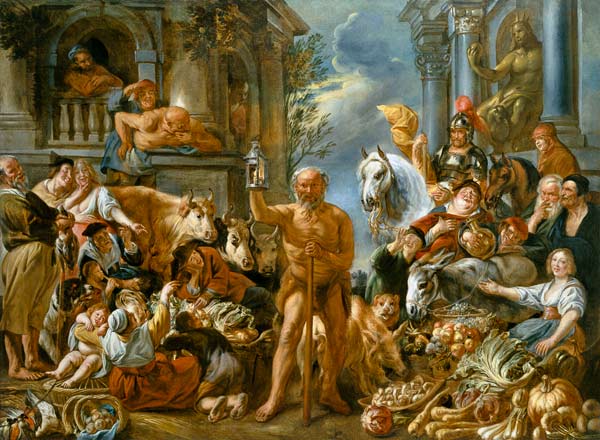
Searching for an Honest Man
Leon Kass had plenty to say about the state of the humanities as the 2009 Jefferson Lecturer.
I particularly like this:
"Everyone has heard the story of Diogenes the Cynic who went around the sunlit streets of Athens, lantern in hand, looking for an honest man. This same Diogenes, when he heard Plato being praised for defining man as “an animal, biped and featherless,” threw a plucked chicken into the Academy, saying, “Here is Platonic man!” These tales display Diogenes’ cynicism as both ethical and philosophical: he is remembered for mocking the possibility of finding human virtue and for mocking the possibility of knowing human nature. In these respects, the legendary Diogenes would feel right at home today in many an American university, where a professed interest in human nature and human excellence—or, more generally, in truth and goodness—invites reactions ranging from mild ridicule for one’s naiveté to outright denunciation for one’s attraction to such discredited and dangerous notions.
Tracing the stories about Diogenes the Cynic to their source, in Diogenes Laertius’ Lives of Eminent Philosophers, one discovers that the apocryphal story is somewhat embroidered if not incorrect. Yes, Diogenes lit a lantern in broad daylight, but he did not say he was looking for an honest man. What he said was, “I am looking for [or ‘seeking’] human being”—anthrôpon zeto—either a human being or the human being, either an exemplar or the idea of humanity, or both. To be sure, purporting to seek the answer by means of candlepower affirms Diogenes’ badge as cynic. But the picture also suggests a man who refuses to be taken in by complacent popular beliefs that we already know human goodness from our daily experience or by confident professorial claims that we can capture the mystery of our humanity in definitions. But mocking or not, and perhaps speaking better than he knew, Diogenes gave elegantly simple expression to the humanist quest for self-knowledge: I seek the human being—my human being, your human being, our humanity. In fact, the embellished version of Diogenes’ question comes to the same thing: to seek an honest man is, at once, to seek a human being worthy of the name, an honest-to-goodness exemplar of the idea of humanity, a truthful and truth-speaking embodiment of the animal having the power of articulate speech."